
amazon affiliate program
Amazon Affiliate Program: How It Works and Whether It Fits Your Ecommerce Strategy

Begin with the decision Amazon affiliate activity must serve
Amazon affiliate activity is a channel decision, not a standalone growth promise. Before you create links, recruit partners, or pay for management, decide what role Amazon should play in your ecommerce strategy.
Your business may want to:
- Send qualified demand to Amazon product listings.
- Give creators or publishers a way to recommend your products.
- Reach customers who prefer researching or buying through Amazon.
- Add an Amazon-focused channel beside your owned store and other acquisition channels.
- Learn whether partner-driven traffic can fit your product economics.
Those goals lead to different operating requirements. A business focused on product discovery may need relevant creators and content publishers. A business focused on measurable sales may need tighter link, commission, and reporting decisions. A business with limited internal capacity may need help with recruitment, partner support, or compliance work.
The practical question is not whether affiliate activity sounds attractive. The practical question is whether the channel’s destination, economics, operating work, and policy conditions fit your business.
Amazon’s program information describes product-related content from influencers and associates as a way to help customers research and discover products. Amazon’s participation guidance also limits Program Content to sending users and sales to an Amazon Site and requires links to the related product-detail page or another relevant Amazon page. That creates a clear decision path for you: identify the customer action you want, identify the partner or content format that can support it, and then test whether the destination and commission structure make commercial sense.
This guide explains that path, then separates participation in Amazon’s programs from the brand-side work of running an affiliate channel. It does not promise approval, earnings, rankings, traffic, or sales.
Run a Two-Gate Review: Policy Fit Before Commission Economics
Use a two-gate review before treating Amazon affiliate activity as an ecommerce channel. The first gate is whether the intended participation route, content, and links fit the applicable Amazon terms. The second is whether the relevant commission information can be evaluated against the business’s product economics and channel role. This sequence keeps a policy question separate from an economic one.
Gate 1: map the participation route to applicable terms. Amazon Associates is Amazon’s native publisher program. Amazon’s Operating Agreement says participants must accept the agreement and its incorporated Program Policies without change. Amazon’s participation guidance says Program Content must send users and sales to an Amazon Site and link to the related product-detail page or another relevant Amazon page. Amazon also states that participating influencers and associates can earn affiliate commissions on purchases and ad revenue from clicks on sponsored products. Together, those points explain the connection among a partner’s content, the Amazon destination, and possible commission income; they do not provide an individualized approval decision.
Gate 2: compare commission information with product economics. Start with the program and category table that applies to the proposed activity. Amazon’s standard commission table lists 10.00% for Luxury Beauty, 5.00% for Digital Music, and 4.50% for Physical Books, Kitchen, and Automotive. Amazon’s Creators Ads table lists different figures, including 5.00% for Luxury Beauty and Amazon Coins, 4.00% for Furniture and Home, and 0.50% for Physical Video Games and Video Game Consoles. A displayed rate is an input for planning, not a forecast of earnings. Keep traffic, purchases, commission income, and gross product revenue as separate measures.
Record four decisions: which participation route and terms apply, which commission table is relevant, how the category information compares with product economics, and which measurements the business will use. If any of those remain unresolved, keep the activity in review rather than treating a link, a traffic figure, or a rate as evidence that the channel fits. This policy-to-economics sequence is the article’s practical test.
Use a separate capacity check after the fit review. Amazon Associates is Amazon’s native publisher program, while brand-side Amazon affiliate program management is a separate operating function for the brand. Participation therefore answers a different question from whether the brand has the capacity to handle the operating work itself.
For an in-house path, name the owner for each responsibility and define the reporting routine before launching. If the open issue is narrower, targeted consulting can focus on network selection, recruitment, or incentive design; if the brand wants day-to-day responsibility handled externally, compare a managed service with the responsibilities it would cover. The choice is about operating capacity, not a requirement to use outside support.
A useful result from the review is a bounded decision: continue with internal preparation, seek a specific piece of guidance, or evaluate managed support. That keeps the support question separate from whether Amazon activity fits the business’s goals, product economics, and measurement plan.
Overview
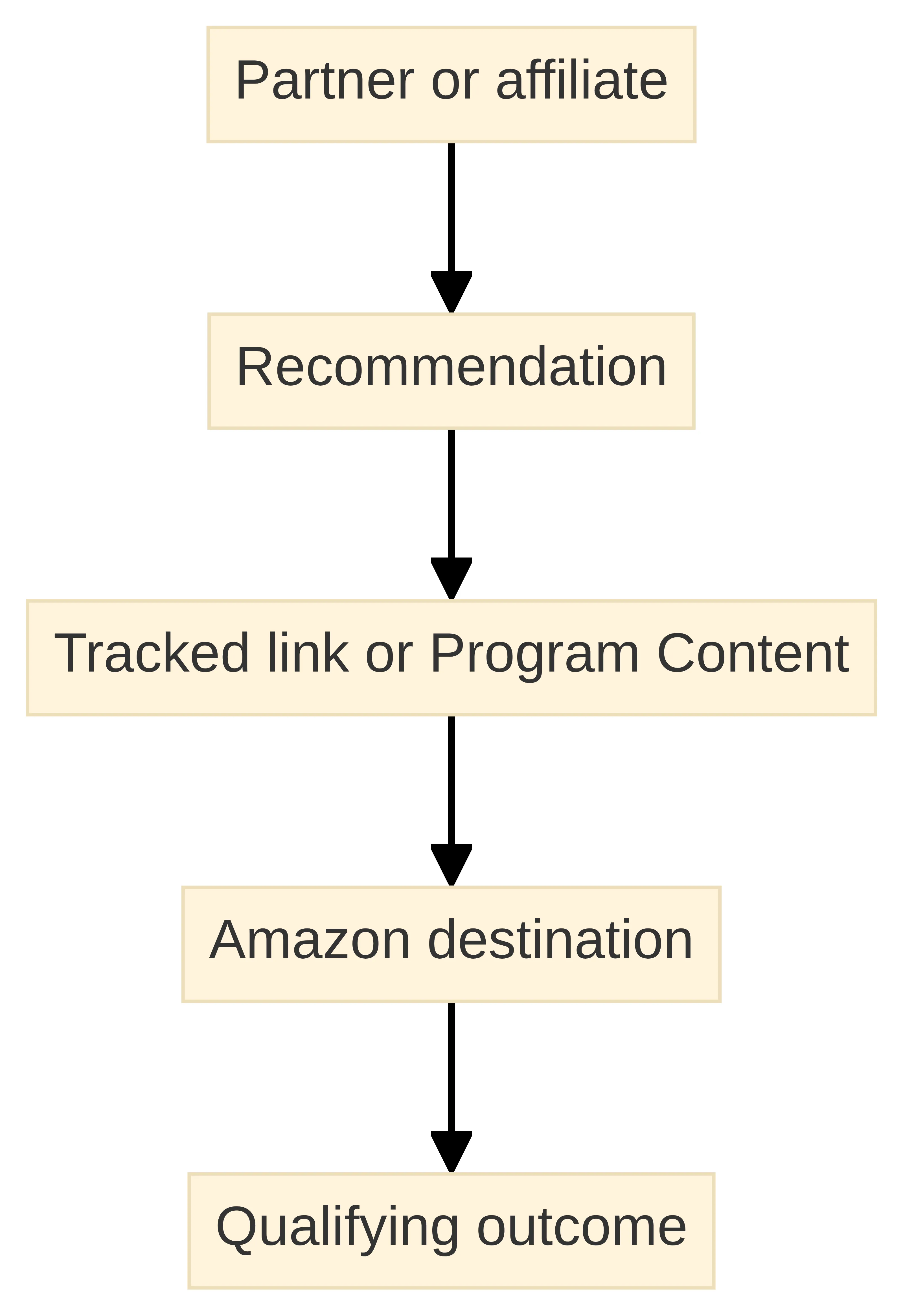
The Amazon affiliate ecosystem includes Amazon’s native Associates and Influencer programs, participants who publish or recommend products, Amazon destinations, and rules governing content and commissions. The central relationship is simple: a participant uses approved program materials or links to direct attention to an Amazon product page, and the applicable terms determine whether a qualifying action can generate commission income.
Participation and management are separate decisions. Amazon’s selected program information describes influencers and associates as participants with a meaningful social-media following and says current qualification requires a YouTube, Instagram, TikTok, Facebook, or Pinterest account. Amazon’s Operating Agreement separately requires participants in the Associates Program to accept the agreement and incorporated Program Policies without change. These points help you frame eligibility as a current-policy question rather than as an assumption based on your product category or marketing experience.
The channel can fit several customer-journey roles. A creator may introduce a product through social content. A content publisher may help with research through an article or other product-related material. An Amazon-focused traffic source may send external demand to a relevant Amazon listing. Each format still needs a defined destination, an approved way to use content, and a measurement plan.
Your evaluation should answer four questions:
- What customer action should Amazon support?
- Which partner format can reach that customer with relevant product context?
- Do commissions and product economics leave room for the channel?
- Who will manage the work and policy requirements?
Amazon also describes the license for specified Program Content uses as limited, revocable, non-transferable, non-sublicensable, non-exclusive, and royalty-free, subject to its agreement, policies, and specifications. Your operating plan therefore needs to treat content use and destination rules as part of channel design, not as administrative details added after recruitment.
Separate Amazon participation from brand-side program management
Amazon participation gives you access to a program governed by Amazon’s terms; brand-side program management is the work of making an affiliate channel operate for your business.
That difference prevents a common planning error: treating enrollment or link creation as the whole program. Participation addresses whether you can take part under the applicable terms. Management addresses how your business selects partners, sets expectations, supports them, reviews activity, handles commissions, and decides what to change.
You can separate the work into two layers:
- Program participation: accepting applicable terms, using approved materials, following content and link rules, and operating within the program’s requirements.
- Brand-side management: defining goals, recruiting or activating partners, setting commercial terms, supporting partners, tracking activity, reviewing results, and maintaining an operating cadence.
The first layer is controlled by the program rules. The second depends on your resources, priorities, and chosen operating model.
This distinction also changes how you compare internal work with outside support. If your team already has partner relationships, analytical capacity, and time for recurring program work, you may need only a defined internal process or targeted guidance. If the gap is ongoing recruitment, activation, reporting, partner support, or compliance coordination, you are assessing an operating service rather than simply looking for access to Amazon.
Write the boundary down before making a decision. List what Amazon controls, what your business controls, and what a third party would be expected to own. A clear boundary makes cost, accountability, and the next step easier to evaluate.
Match partner formats to the customer journey
Partner format matters because the same product can need discovery, explanation, comparison, or a direct route to an Amazon listing. Amazon’s selected program information describes influencers and associates as participants who bring product-related content onto Amazon, while a selected 2026 strategy guide describes management as working with creators, publishers, and affiliates that drive external traffic to Amazon listings.
Amazon’s selected information says current qualification requires an account on YouTube, Instagram, TikTok, Facebook, or Pinterest and describes participants as having a meaningful social-media following.
- Content publishers: Articles, guides, reviews, or other product-related content can support research before a person reaches an Amazon listing. The relevant question is whether the content gives the product enough context for the intended customer action.
- Amazon-focused external traffic: A partner can direct people from an external channel to a relevant Amazon product-detail page. Amazon’s participation guidance sets the destination boundary for Program Content and links.
- Brand-side partner relationships: Your business may need ongoing communication, activation, support, and reporting after a partner is identified. Those tasks belong to management rather than to the existence of a native Amazon program.
Do not choose a format because it is familiar. Choose it because the format fits the customer question, product category, destination, and measurement you intend to use.
We recruit content, loyalty, deal, influencer, and sub-network partners based on category fit rather than bulk applications. That is our stated approach to partner recruitment, not a general rule for every Amazon program. If you ask us to support your program, use category fit as a discussion point: define the audiences, products, content requirements, and destination rules before judging the size of a proposed partner list.
A short partner brief should specify the product or product group, intended customer action, acceptable content context, Amazon destination, commission question, and owner for partner communication. That brief gives each potential partner type a defined job.
Review participation as a current-policy question
Amazon participation depends on the program and the rules in force when you apply or operate. Amazon’s Operating Agreement says that a person or entity participating in the Associates Program must accept the agreement and incorporated Program Policies without change.
These statements support a general review process, not an individual approval decision. Your account, content, audience, and intended use may need to be assessed against the applicable Amazon requirements before you rely on participation.
Review the following before building the channel:
- Program identity: Determine whether your planned activity concerns Associates, the Influencer Program, or another Amazon-specific format.
- Participant conditions: Read the current qualification language for the program you intend to use.
- Agreement acceptance: Identify the agreement and incorporated policies that govern participation.
- Account and content fit: Check whether your planned account, audience, and content format meet the stated conditions.
- Operating owner: Assign responsibility for keeping the process aligned with policy changes.
Recheck the applicable Amazon information before applying or publishing program content.
Amazon’s Operating Agreement also says content posted on Amazon.com must follow Amazon Community Guidelines, including a prohibition on customer reviews created, edited, or removed in exchange for compensation. That condition matters if your plan involves reviews, testimonials, or incentives. Keep compensated review activity outside any approach that would conflict with the stated guideline, and assign a policy owner before partners begin publishing.
Build compliance into the operating model
Amazon compliance belongs in the workflow because link destinations, Program Content, marks, data, and content uses have stated limits.
Turn those boundaries into operating checks rather than relying on memory. Your process should identify:
- Which approved Program Content or links a partner may use.
- Which Amazon destination each link should reach.
- Who reviews a link or content placement before publication.
- How changes to product pages, content, or partner materials are handled.
- Who records policy questions and escalates them for review.
- How you pause or correct activity that does not match the applicable requirements.
The goal is not to create a large approval bureaucracy. The goal is to make responsibility visible before a partner publishes.
Amazon’s Operating Agreement incorporates Program Policies and says participants must accept the agreement without change. The same agreement says content posted on Amazon.com must follow Amazon Community Guidelines, including the prohibition on compensated customer reviews that are created, edited, or removed. Keep this condition close to partner recruitment and content review, especially if your promotion plan includes reviews, incentives, or customer-facing claims.
A useful operating record can be brief: partner, content format, destination, approval owner, applicable rule, review date, and correction path. That record gives your team a practical place to work from when the program or a partner’s activity changes.
Read commission information as program- and time-sensitive
Amazon commission information is not one universal percentage for every product and program context. The selected standard commission table lists 10.00% for Luxury Beauty, 5.00% for Digital Music, and 4.50% for Physical Books, Kitchen, and Automotive. A separate selected Creators Ads table lists 5.00% for Luxury Beauty and Amazon Coins, 4.00% for Furniture and Home, and 0.50% for Physical Video Games and Physical Video Game Consoles.
The differing examples show why you should identify the table and program context before using a rate in a forecast. The Luxury Beauty example is 10.00% in the selected standard table and 5.00% in the selected Creators Ads table. Those are not interchangeable planning inputs.
Use this sequence when reviewing commission information:
- Name the Amazon program or feature connected to the rate.
- Identify the product category used for the calculation.
- Record the table’s effective or retrieval context where available.
- Check whether the rate applies to the action and partner format you plan to use.
- Recalculate your economics if Amazon changes the applicable information.
Treat the rates as time-sensitive program information, not as a permanent commercial promise.
Your financial model should use the rate that actually corresponds to the planned activity, then test the result against product economics. Include the product price, expected commission basis, partner compensation if applicable, operational cost, returns or cancellations where relevant to your internal model, and the value of the customer or order to your business.
Do not start with a headline percentage and work backward to justify the channel. Start with the action you want, identify the governing rate information, and then decide whether the remaining economics support the work required.
Test economic fit before choosing a channel role
Economic fit depends on the relationship between the channel’s contribution and the work required to operate it. A commission percentage can look attractive while producing little useful contribution if the product has thin margin, the partner requires substantial support, or the activity merely shifts demand from a channel you already own.
Assess the channel with a written model that answers these questions:
- What product or product group will the channel support?
- What customer action counts as useful: discovery, an Amazon purchase, new demand, or another defined outcome?
- Which commission table and program context apply?
- What costs belong in the decision, including partner payments, internal time, management support, creative work, and reporting?
- What margin or contribution remains after the channel’s direct and operating costs?
- How will you distinguish partner-driven activity from demand that would have reached Amazon without the partnership?
The model does not need to predict an exact result. It needs to show the conditions under which the activity would be worth running and the conditions under which you would pause or change it.
Those tasks carry time and coordination requirements even before you assess the commission table. Use both sides of the decision: the selected rate information for the planned program context, and the actual management work your team must perform.
Set a review window and decision rules before launch. For example, define what data you will inspect, who will review it, which partner activity requires correction, and what would justify continuing, changing, or ending the test. Keep the rule tied to your economics and channel role rather than to an unsupported revenue expectation.
Choose the operating model that matches available capacity
Your operating model should match the amount of recurring work your team can own. Amazon participation does not answer who will recruit partners, support them, check content and links, review commissions, or interpret performance. Make those assignments before you decide how much outside help you need.
Compare the three practical models:
- Internal management: Your team owns participation, partner communication, content and link checks, commission decisions, reporting, and program changes. Choose this path when those responsibilities have clear owners and enough recurring capacity.
- Targeted guidance: Your team keeps day-to-day ownership but brings in specialist help for a defined gap, such as network selection, recruitment planning, or incentive design. Choose this path when the operating structure exists but a decision or skill needs support.
- Outsourced management: An outside operator owns an agreed set of recurring tasks, which may include strategy, partner recruitment, activation, compliance coordination, optimization, reporting, and partner relationships. Choose this path when the gap is ongoing execution rather than a single question.
The right model can change as the program changes. Record the current gap instead of assuming that a larger service scope is automatically necessary.
Use that scope as a checklist when you compare outside support. Ask which tasks are included, which decisions remain with you, what information the operator needs, and how the handoff works if the engagement changes.
Do not compare an internal process with a managed service by name alone. Compare ownership, cadence, deliverables, decision rights, and the work that remains with your team.
Key Highlights
Amazon affiliate activity makes sense only when the destination, partner format, economics, and operating capacity fit the job you want the channel to perform. Keep these points in view:
- Amazon describes Influencer and Associate content as helping customers research and discover products.
- Amazon’s participation guidance requires Program Content to send users and sales to an Amazon Site and to link to a related product-detail page or relevant Amazon page.
- Commission tables can differ by program context, so use the table that matches the activity you plan to run.
- Participation and brand-side management are separate decisions.
- Internal ownership, targeted guidance, and outsourced management solve different capacity problems.
Use these points to narrow the decision before you spend time recruiting partners or designing a broader program.
Choose self-management, targeted guidance, or managed support
The choice between self-management, targeted guidance, and managed support should follow the gap you have documented. We offer hourly consulting for brands that keep their affiliate program in-house, including guidance on network selection, recruitment, and incentive design. We also provide full-service affiliate program management with a senior account manager handling day-to-day operations, reporting, and partner relationships.
Use self-management when your team can consistently own the work and already has a workable process. Use targeted guidance when you can execute but need help with a defined planning or design question. Use managed support when recurring recruitment, activation, partner support, commissions, reporting, or day-to-day ownership exceeds your internal capacity.
Before choosing, write down:
- The tasks you can own every week or month.
- The decisions that need specialist input.
- The partner types and product groups you intend to pursue.
- The policy and link checks your process must cover.
- The reporting cadence and measures you will review.
- The work that must remain with your team even if support is outsourced.
Then match the engagement to the smallest clear gap. If the gap is not defined, start with diagnosis rather than committing to a broad operating scope.
We offer a free program audit, hourly consulting, and full-service affiliate program management. We work with Amazon Associates and the Amazon Influencer Program alongside other major affiliate networks. These are available support paths, not a requirement for participating in an Amazon program.
If your team is deciding whether Amazon-focused activity fits at all, first document the customer action, product economics, partner format, policy requirements, and internal owner. If the channel appears suitable but the operating gap is unclear, an audit or defined consulting question can help frame the decision. If the gap is recurring execution, compare a managed scope against the tasks you need covered and the responsibilities you intend to retain.
Turn the evaluation into a bounded next step
Your Amazon decision is ready for a next step when you can state the channel’s job in one sentence, name the Amazon program or context involved, identify the partner format, show the relevant commission information, and assign ownership for policy, links, partner work, and reporting. If any of those fields remains unclear, keep the next step narrow: resolve the missing decision rather than treating participation as a commitment to a full program.
We can support different gaps through a free program audit, hourly consulting, or full-service affiliate program management. A qualified professional must determine individual suitability for your business, financial model, and operating circumstances. Use your written channel brief to decide which type of discussion, if any, fits the question you still need to answer.
The useful outcome is a documented choice: proceed with an internal process, seek targeted guidance, or evaluate an agreed managed scope.
What should an ecommerce business verify before starting Amazon affiliate activity?
What is the Amazon affiliate program and how does it work?
The Amazon affiliate program allows participants to earn commissions by promoting Amazon products through approved content and links.
What are the commission rates for different product categories in the Amazon affiliate program?
Commission rates vary by product category. For example, Luxury Beauty products may earn a commission of 10%, while Digital Music earns 5%, and Physical Books earn 4.5%. It’s important to check the specific commission table for the applicable program context.
What is the difference between participating in Amazon Associates and hiring an outsourced program manager?
Participating in Amazon Associates involves accepting Amazon’s terms and using approved materials to promote products. In contrast, hiring an outsourced program manager means engaging a specialized agency to handle the recruitment, management, and optimization of your affiliate program, which includes ongoing operational tasks.
What types of partners can I work with in the Amazon affiliate program?
You can work with various types of partners, including creators and influencers who promote products through social media, content publishers who provide articles or reviews, and external traffic sources that direct users to Amazon product pages. Each partner type serves a different role in the customer journey.
How can I evaluate whether the Amazon affiliate program fits my ecommerce strategy?
To evaluate the fit, consider your business goals, product economics, and the role of Amazon in your marketing strategy. Assess whether the commission structure aligns with your margins, the type of traffic you can generate, and whether you have the resources to manage the affiliate program effectively.
What should I do if I want to manage my Amazon affiliate program in-house?
If you choose to manage your Amazon affiliate program in-house, ensure you have clear ownership of tasks such as partner recruitment, content approval, compliance monitoring, and performance tracking. You may also consider seeking targeted guidance for specific areas where you need expertise.
Need help applying this?
Let's pressure-test your affiliate program.
Surge runs affiliate programs for ecommerce brands across the U.S. The audit is complementary — book a call to see what a healthier publisher mix and tighter commission design could do for your numbers.
LET'S SURGE!