
amazon affiliate program
Amazon Affiliate Program: How It Works and Whether It Fits Your Ecommerce Business

What the Amazon affiliate program actually connects
Amazon Associates connects promotional content, a tracked link, an Amazon shopping visit, and a qualifying purchase. An Associate places a Special Link in a website, social presence, or other permitted promotional setting. When a customer follows that link and buys an eligible item or service on an Amazon site, the Associate may receive commission income subject to the program’s limitations.
The commercial relationship has three distinct parties:
- Amazon supplies the destination, products or services, and program rules.
- The Associate publishes or distributes the link and brings a customer to Amazon.
- The customer clicks, shops, and may complete a qualifying purchase.
A publisher or creator can act as the Associate, but the role is defined by the link-based promotion rather than by a particular content format. Amazon may also provide Associates with links, widgets, marketing content, APIs, and other Program Content for promoting Amazon offerings.
Your ecommerce business needs to separate two questions before treating this channel as a growth plan. First, can your business participate as an Associate or work with publishers and creators who do? Second, does sending traffic to Amazon support the business objective you actually need to achieve?
An Amazon-focused affiliate activity may make sense when your goal involves product discovery, creator partnerships, or traffic directed to Amazon listings. It does not automatically measure sales on your own storefront, replace your own conversion analytics, or prove that an external click created incremental demand. Treat the program as a specific acquisition and attribution path, not as a general substitute for your ecommerce marketing system.
The basic path from link to qualifying purchase
Amazon’s qualifying-purchase process begins when a visitor follows an Associate link to Amazon.com. Amazon’s help content says commission income is earned when the visitor makes a purchase and the item is dispatched. The sequence is therefore more specific than a simple click-based payout.
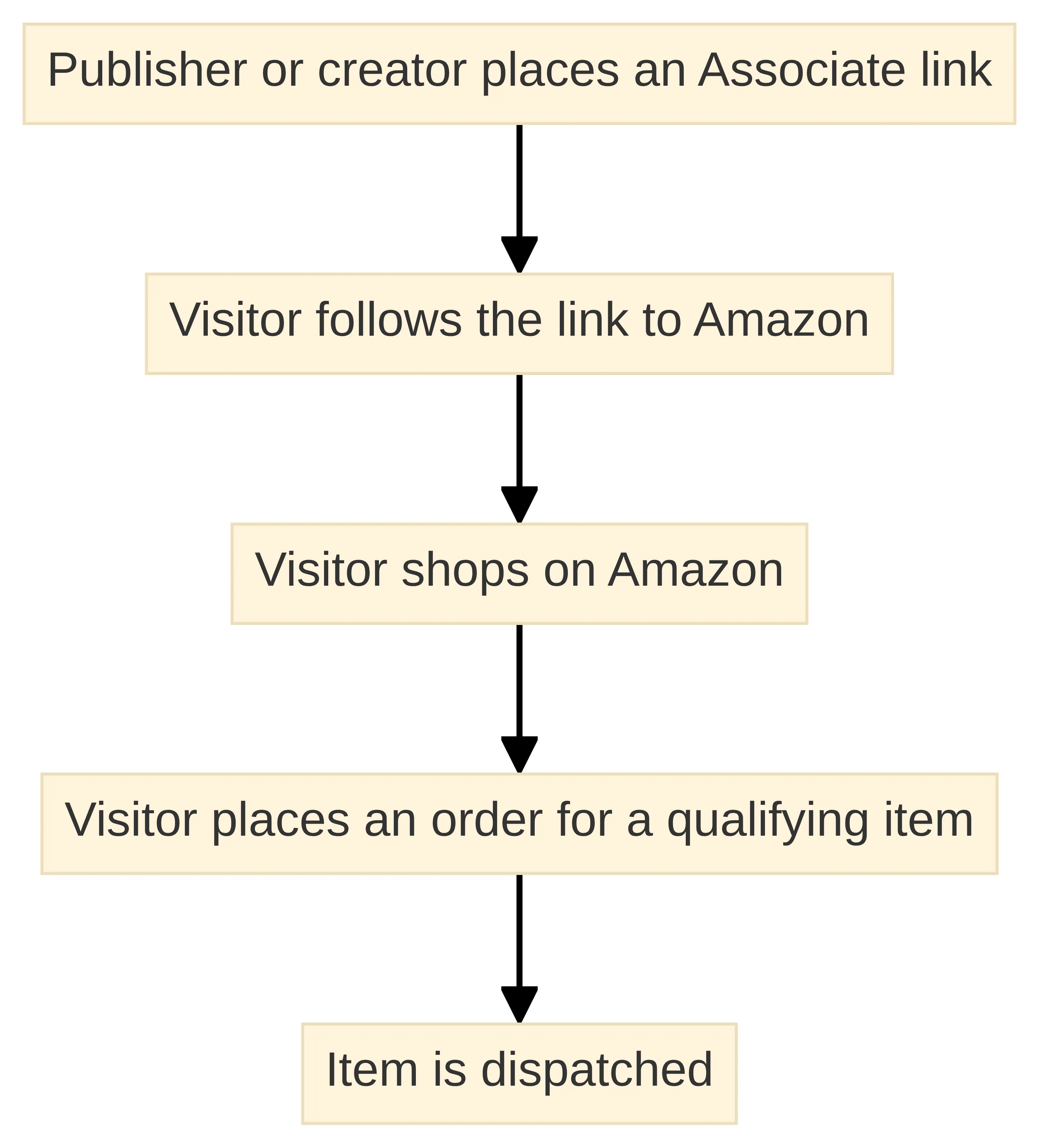
Use this five-step path when you map the channel:
- A publisher or creator places an Associate link. The link identifies the Associate responsible for the referral.
- A visitor follows the link to Amazon. The destination may be a product page, a search-results page, the Amazon.com home page, or another Amazon.com page.
- The visitor shops on Amazon. The click creates the relevant referral context for the Associate link.
- The visitor places an order for a qualifying item. The transaction must meet the program’s conditions.
- The item is dispatched. Amazon’s help content identifies dispatch as part of the point at which commission income is earned.
A click is not the same thing as commission income. Your reporting should keep clicks, orders, qualifying purchases, and dispatched items as separate stages rather than treating every referral as revenue.
That distinction also affects how you evaluate partner performance. A publisher may generate substantial traffic without producing qualifying purchases, while a smaller source may send fewer visitors who complete more orders. Set up your internal review around the event that matters to the program and to your economics, then keep the link source identifiable through the rest of your reporting. Amazon’s terms remain the authority for which purchases qualify.
What Associates can link to
Amazon Associates can link to several types of Amazon destinations, including individual product pages, search-results pages, the Amazon.com home page, and other Amazon.com pages. Amazon also says Associates can place product search boxes on their sites.
The destination should match the promise made in the promotional content. A review of one product should lead to that product or a clearly related destination. A category guide may use a category or search-results page. A broader shopping recommendation may lead to the Amazon home page, but that path gives you less control over where the customer continues.
Choose the destination before recruiting or briefing a partner. The choice affects the customer journey, the relevance of the click, and the way you interpret the resulting traffic.
Your destination plan should answer three practical questions:
- What did the content promise? The link should take the visitor to a place where that promise can be acted on.
- What can you measure afterward? Keep the page type and partner source visible in your tracking record.
- What happens if the product or page changes? Assign responsibility for checking links, updating content, and handling discontinued or unavailable items.
These are operating decisions, not proof that any particular destination will improve performance. A well-organized link map gives you a clearer basis for reviewing traffic and partner activity.
How commission and attribution mechanics shape the channel
Amazon’s stated attribution window gives you a specific condition to account for: a qualifying item placed in the customer’s shopping cart within 24 hours of the customer arriving through an Associate link can earn commission income. Amazon says that window closes when the customer submits the order or reenters Amazon through another Associate’s link. A later visit through the Associate’s link opens a new 24-hour window.
The timing matters because the original click does not control every later shopping event indefinitely. A customer can click today, return through another Associate link, and change which referral context applies. Your partner report should therefore preserve the click date, link source, order status, and any available transaction context instead of relying only on a monthly traffic total.
Amazon states that commission income is calculated on the sale price of each qualifying item rather than its list price. Your business case should use the price basis that applies to the program terms, not a displayed list price that the customer does not pay.
This creates a direct economic review sequence:
- Record the product category and the price basis used in the calculation.
- Separate the commission amount from your gross sales value.
- Account for partner incentives, management time, creative work, and any other channel cost.
- Compare the resulting contribution with the value of the customer or transaction you are trying to acquire.
The program’s commission mechanics do not establish your business’s margin, customer lifetime value, or acceptable acquisition cost. You must calculate those separately.
Amazon Attribution and Amazon Associates links should not be treated as interchangeable labels. In a January 23, 2025 LinkedIn post, David Seybert distinguished Amazon Attribution links, where the benefit goes to the brand, from Creator Connections links, which use Amazon Associates links and benefit publishers. That distinction describes a difference in the party receiving the program benefit, not a universal answer for every campaign.
Use the distinction as a diagnostic question: are you trying to compensate a publisher or creator, measure brand-directed activity, or do both through permitted arrangements? Check the applicable Amazon terms before combining tracking approaches, because the same traffic or link may not support duplicate compensation.
Why a displayed rate is not a universal business case
Amazon’s displayed Creators Ads table lists fixed onsite Associates Program commission rates for direct qualifying purchases in specific product categories. The table includes 5.00% for Luxury Beauty, Luxury Stores Beauty, and Amazon Coins; 4.00% for Furniture and Home categories listed there; and 0.50% for Physical Video Games and Video Game Consoles.
Those figures illustrate category variation. They do not give you one rate to apply across every Associates transaction.
The supplied Amazon table is labeled for Creators Ads and particular product categories, so you should not generalize its figures to every Associates transaction. Read the applicable schedule and terms for the activity you are evaluating, then record the category, program context, and transaction type beside the rate.
Your economic review should also test whether the rate fits the work required to produce the sale. A percentage that appears attractive before partner payments, content production, tracking review, and account management may look different after those costs. Use the applicable rate as one input, not as the conclusion.
Associates participation versus an ecommerce brand’s Amazon strategy
Amazon Associates participation and an ecommerce brand’s Amazon strategy solve different problems. Associates participation concerns promoting Amazon offerings through tracked links. An ecommerce brand’s broader strategy may concern selling its own products, sending traffic to its own store, selling through Amazon, or working with publishers and creators.
If your immediate goal is to increase sales on your own website, an Amazon Associate link sends the customer to Amazon rather than to your storefront. If your goal is to support products already offered on Amazon, the Associates path may be relevant, but you still need to define the partner, destination, qualifying event, economics, and reporting owner.
Write the destination and commercial objective in one sentence before you assess the channel. If those two items point to different marketplaces, do not combine their results in one headline number.
A useful strategy record distinguishes four layers:
- Channel objective: the business result you want to examine.
- Traffic owner: the publisher, creator, or other partner responsible for promotion.
- Destination: the Amazon page or storefront where the customer takes action.
- Measurement owner: the person responsible for reconciling clicks, qualifying purchases, commissions, and costs.
This record prevents a common category error: judging a publisher-compensation channel by the same measure you use for direct ecommerce sales. It also gives you a clear boundary for deciding whether the next work belongs in partner management, storefront analytics, Amazon operations, or a combination of those areas.
Influencer activity is a related but separate consideration
Amazon’s Influencer Program is a country-specific program available in select countries. Amazon says an eligible Associate must meet qualitative and quantitative thresholds, complete registration, and comply with the applicable agreement and Influencer Program Policy.
For a United States business, influencer activity therefore requires its own participation check. Do not assume that an existing social following, an existing Associates account, or a brand partnership automatically satisfies the conditions for the Influencer Program. Treat the Influencer Program as a related path with its own eligibility and policy review.
Your influencer decision should answer a narrower question than whether creator marketing sounds attractive:
- Is the creator operating as an Associate, an Influencer, or under another permitted arrangement?
- Is the creator’s audience being sent to Amazon or to your own site?
- Who receives the commission or other agreed compensation?
- Which link, campaign, and purchase events will you reconcile?
- Which current Amazon policy applies to the activity?
Resolve those questions before you compare creators or estimate channel economics. If the participation route is unclear, pause the launch and identify the applicable Amazon terms first.
What current verification must cover before participation
Amazon’s current Operating Agreement, program policies, and any applicable Influencer Program Policy should be the documents you use to check participation conditions before acting. The agreement governs the Associates relationship, while the Influencer Program Policy adds separate conditions for that program. Use the versions in force when you apply or launch rather than relying on an old article, saved rate, or informal summary.
Your verification checklist should cover:
- Participation route: Associates, Influencer, or another Amazon program.
- Application and qualification conditions: the conditions that apply to your account type, location, and activity.
- Link and content rules: how Special Links and Program Content may be used.
- Commission conditions: qualifying purchases, dispatch, category treatment, and the applicable schedule.
- Attribution boundaries: the permitted relationship between Associate links, other Amazon measurement products, and partner compensation.
- Disclosure and operating duties: the responsibilities attached to publishing promotional content and maintaining the account.
Amazon may provide Associates with data, images, text, link formats, widgets, marketing content, APIs, and other linking tools as Program Content for advertising Amazon offerings. Treat those tools as governed materials, not as permission to reuse every Amazon asset in every context.
Before launch, assign one person to record the policy version reviewed, the program route selected, the link method used, and the questions that remain unresolved. Do not treat the checklist as approval. Treat it as a gate: unresolved participation, content, attribution, or commission conditions should stop implementation until you have an answer from the applicable Amazon documentation or support channel.
Evaluate fit across five business questions
Your business can evaluate Amazon-focused affiliate activity through five questions that connect channel mechanics with operating reality. A clear answer to each question gives you a more useful decision than a general judgment about whether affiliate marketing is attractive.
-
What is the destination and objective? Decide whether the activity sends customers to Amazon products, Amazon search results, or another Amazon page, and state whether you are evaluating sales, publisher compensation, product discovery, or a brand measurement goal. If the destination does not match the objective, redesign the activity before recruiting partners.
-
Who owns the customer path? Identify the publisher or creator, the Associate account, the destination, and the person responsible for link maintenance. If no one owns those handoffs, do not treat the channel as ready for launch.
-
What economics apply? Record the applicable category, sale-price basis, commission schedule, partner cost, and operating cost. Amazon states that commission income is based on the qualifying item’s sale price, while its displayed Creators Ads table shows category-specific rates. Use the applicable terms rather than a headline percentage.
-
How will attribution be reconciled? Track the link source, click date, purchase status, dispatch status, and the 24-hour shopping-cart condition Amazon describes. If another Associate link can close the window, preserve enough information to investigate the change instead of assigning every order to the first click.
-
Can you operate within the applicable rules? Review the current Associates agreement and policies, then check any separate Influencer conditions if creators are involved. If your team cannot maintain links, review partner activity, document policy decisions, and reconcile commissions, choose a narrower test or obtain operating support before expanding.
Your decision record should end with one of three boundaries: proceed with a defined test, pause until a policy or measurement question is resolved, or decline the channel because the destination and economics do not fit the business objective. The record does not need to predict income. It needs to show what you will measure, who will own the work, and what would cause you to stop or change the activity.
Choose between self-directed evaluation and outside support
Self-directed evaluation can fit your business when an internal team can define the destination, review Amazon’s current terms, build the link and partner record, monitor qualifying-purchase reporting, and keep the economics separate from other ecommerce channels. Start with a limited scope: one objective, a defined partner group, a documented tracking method, and a review date tied to the records you can actually obtain.
Keep the work internal when the remaining gap is mainly prioritization or documentation. Assign an owner for each operating task and write the escalation point for policy, attribution, or commission questions. A small, controlled evaluation is easier to assess than a broad launch with unclear responsibility.
Outside support may fit when your team needs help selecting a network or program path, recruiting partners, designing incentives, or deciding how Amazon activity should fit the existing affiliate operation. We offer hourly consulting for brands keeping affiliate programs in-house, including guidance on network selection, recruitment, and incentive design. We also offer a free program audit, hourly consulting, and full-service management.
Full-service management may fit when the unresolved need is day-to-day ownership rather than a single strategic question. We are a full-service agency specializing in affiliate program management. A senior account manager on our team manages day-to-day operations, including reporting and partner relationships, and we manage recruitment, activation, commissions, partner support, and reporting.
Choose the engagement level by the work you need owned. Use consulting for a defined internal decision, an audit for a program review, or management when ongoing partner and reporting operations need an assigned external owner.
Record the decision before taking the next step
Your Amazon affiliate decision record should state the participation route, destination, partner type, qualifying event, applicable commission terms, attribution window, policy documents reviewed, and person responsible for ongoing reporting. It should also state whether the activity serves an Amazon sales objective, a publisher or creator relationship, or a separate brand-measurement objective.
Use the record to choose a bounded path: evaluate independently, request targeted consulting, or assign ongoing management. Do not treat a commission percentage or a publisher’s reach as a substitute for a documented economic and operating decision. A qualified professional should determine suitability for your specific legal, tax, compliance, and business circumstances.
Once the record is complete, you can identify the unresolved work without promising approval, income, or performance. The appropriate next step is the one that matches that gap: policy review, measurement design, partner planning, or operational ownership.
Need help applying this?
Let's pressure-test your affiliate program.
Surge runs affiliate programs for ecommerce brands across the U.S. The audit is complementary — book a call to see what a healthier publisher mix and tighter commission design could do for your numbers.
LET'S SURGE!