
Amazon Associates
Amazon Associates for DTC Brands: How to Evaluate Its Role in an Affiliate Launch

Start with the referral handoff
Start by mapping the referral handoff: who creates the referral, where the visitor goes, what event qualifies for commission income, and which Amazon rules apply. Amazon describes Associates as an advertising program that pays for qualifying referrals, not as a discount program. That map gives the launch review a concrete starting point.
Use a four-part referral-handoff check for the launch review. Amazon’s published flow sends visitors from an Associate’s site to Amazon.com, where a qualifying purchase may produce commission income. Your first decision is therefore whether your launch needs that Amazon destination, a brand-owned conversion path, or both.
For a DTC brand in Los Angeles, the practical questions are the same as for any other launch location:
- Which audience or publisher would send traffic?
- Where would that traffic complete its purchase?
- Who would own the content, links, policy review, and commercial analysis?
- What would count as a qualifying outcome for your planning?
Answer those questions before discussing recruitment, commission assumptions, or management support. The program may fit one part of your strategy while leaving another part unaddressed.
Separate the destination from the program strategy
Amazon.com is the destination in the Associates flow, while your affiliate strategy is the larger set of choices around partners, content, economics, tracking, and ownership. Amazon says Associates can link to individual products, search-results pages, the Amazon.com home page, or other Amazon.com pages. Those link destinations explain what the program connects; they do not define every affiliate channel your brand may want to operate.
A broader affiliate program can be planned around your own ecommerce site, marketplace activity, or several destinations. The useful distinction is operational:
- An Amazon referral route asks how external content brings people to an Amazon product or shopping page.
- A brand-side affiliate route asks how partners promote your offer and send people to the conversion environment chosen by your brand.
- A wider affiliate network strategy asks how you will recruit, approve, compensate, and manage multiple partner types across a defined program.
These categories can overlap, but they should not be collapsed into one budget line or one success definition. A publisher that can refer an audience to Amazon is not automatically a fit for every brand-owned affiliate initiative. Likewise, a decision to operate a brand-side program does not answer whether Amazon is an appropriate destination for a particular audience.
Use a destination test before you choose the channel role. If the customer journey depends on product discovery and checkout taking place on Amazon, evaluate the Associates rules and economics. If the journey depends on your own storefront, evaluate the tools, partner terms, and measurement required for that separate route. If both matter, document two paths instead of assuming that one program will measure or manage the other.
Identify who creates the referral
The Associate creates the referral by placing a link or other approved recommendation in content that reaches an audience. Amazon says content creators, publishers, and bloggers can use its link-building tools to direct audiences to product recommendations and earn from qualifying purchases and programs. Amazon also describes Influencers and Associates as people who bring product-related content to customers, with the applicable program name identifying that content.
Your brand’s role may be to supply products, product information, creative context, or a commercial reason for pursuing the channel. The Associate’s role is different: that participant controls the audience-facing recommendation and sends the referral to Amazon. Do not treat the existence of a product relationship as proof that a publisher will create useful content, attract relevant traffic, or generate qualifying orders. Those are separate questions for your launch plan.
Map the participant before you assess the opportunity:
- Name the creator, publisher, or content property that would make the recommendation.
- Describe the audience and the content context in which the link would appear.
- State whether the content sends people to a product page, search page, home page, or another Amazon destination.
- Record who owns publication, link maintenance, policy review, and performance analysis.
This map keeps external traffic, creator activity, and brand-side responsibilities separate. It also gives you a concrete basis for deciding whether the program should be part of the initial launch or a later channel test.
Use commission conditions to govern the launch decision
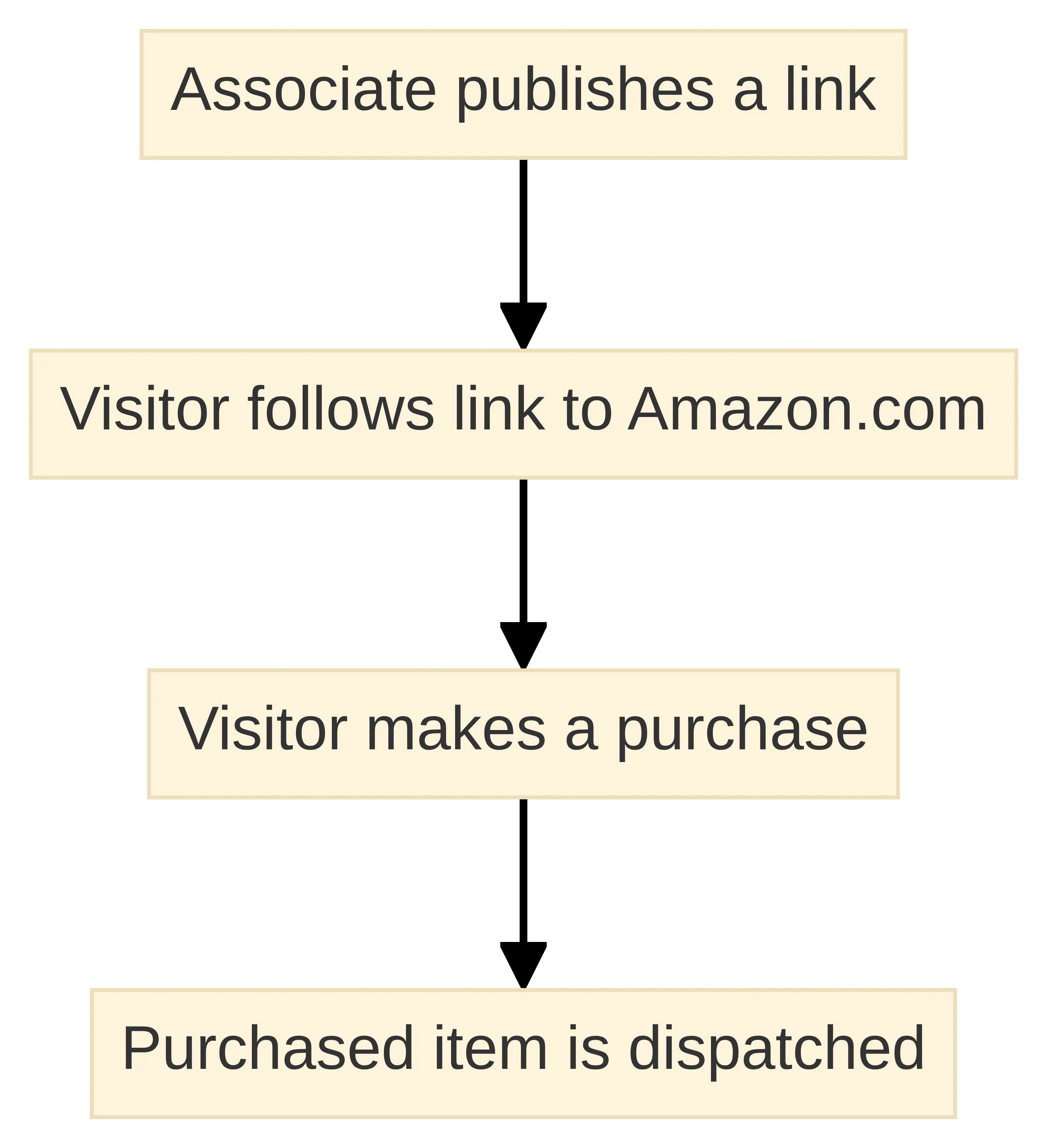
Use Amazon’s commission conditions as a launch-governance checkpoint rather than a performance forecast. Amazon’s description ties commission income to a purchase and dispatch after a visitor follows an Associate link, rather than to link creation or a click alone.
Your launch record should preserve each stage rather than reducing the channel to traffic volume. A practical flow record can include:
- the content location where the referral begins;
- the Amazon destination reached by the link;
- the purchase condition used in your internal forecast;
- the dispatch condition described by Amazon; and
- the payment plan that governs the applicable commission.
Amazon’s description supports a clear boundary: a visitor who follows a link has not yet produced commission income merely by clicking, and a purchase is not the final described condition until the item is dispatched.
Do not add an attribution window, approval assumption, or conversion forecast to this flow unless the applicable Amazon terms and your operating record support it. The useful question is not whether external traffic exists; it is whether your proposed content and audience can move through the full qualifying sequence under the rules that apply when you launch.
Choose linking methods that match the content
Amazon provides several link formats and destinations, so the linking method should follow the content format rather than lead the strategy. Amazon describes customized text links, text-and-image links, and image-only links. It also says Associates can link to products, search-results pages, the Amazon.com home page, or other Amazon.com pages.
Use the available methods as a content-planning decision:
- Use a product link when the content discusses a specific item and the destination should match that item.
- Use a search-results or broader Amazon page when the recommendation depends on a category, comparison, or range of products.
- Use a text-and-image or image-only format when the surrounding page design calls for a visual product presentation.
- Use SiteStripe when an Associate is logged into Amazon with the account used for Associates and wants to create a text link to the Amazon page being viewed.
Amazon says pages using text-and-image product links must be hosted by the Associate. That condition belongs in your content-ownership checklist before anyone chooses a format.
Your selection record should name the content type, intended destination, link format, page owner, and maintenance responsibility. Amazon also describes product search boxes as an available option for an Associate’s site. Treat that as a format choice, not as a reason to assume that a search box will create a commercial result. The link must still lead into the qualifying-order path.
Read the economics as a qualification chain
The economics should be read as a qualification chain: eligible referral, qualifying purchase, dispatched item, and applicable payment plan. Amazon says commission income is calculated on the sale price rather than the list price of each qualifying item, and the applicable payment plan determines the commission. Amazon also says the program is intended to pay for referrals of unrelated customers, not to provide purchase discounts.
A DTC launch model should therefore separate the following inputs:
- referral volume from completed purchases;
- purchase value from sale price used for commission calculation;
- qualifying orders from orders that fail the applicable conditions;
- dispatched items from orders that have not reached that stage; and
- a general commercial assumption from the payment plan that actually applies.
This structure prevents a click count, list price, or headline commission assumption from becoming a forecast by itself. It also gives you a way to compare the Amazon route with other affiliate activity without pretending that their qualification rules are identical.
Orders placed by an Associate or by closely related people are another economic boundary. Amazon says orders made on the Associate’s behalf, including orders by family members, friends, or close acquaintances under the agreement’s criteria, are not eligible for commission income. Do not use internal purchases or informal requests to create a forecast for the channel.
Before you assign the channel a revenue role, write down the product margin you are willing to allocate, the audience you expect to reach, the work required to produce and maintain content, and the qualifying conditions that must be met. If any of those fields depends on an unconfirmed current payment plan or policy rule, mark the decision as conditional rather than presenting a fixed return expectation.
Keep Associates and Influencer activity distinct
Amazon presents its Influencer Program as separate from the Associates Program. Amazon describes selected influencers as having tools to recommend products to followers and potentially publish livestreams, shoppable photos, and videos on a personalized Amazon page. The Associate route, by contrast, centers on link-building tools and referrals from an Associate’s site or content.
The distinction matters when your launch plan names creators. Ask which program and activity you are actually evaluating:
- If the plan is a link from external content to an Amazon product or shopping page, evaluate the Associates path.
- If the plan depends on a personalized Amazon page, livestreams, shoppable photos, or videos, treat the Influencer path as a separate question.
- If the plan includes both, assign each activity its own participant, content, policy, and economics record.
Do not treat an interest in creator activity as proof that every creator belongs in the same program.
Amazon says Influencers and Associates independently determine whether to recommend a product, while Amazon does not modify or edit compliant content. Your brand can define the products and context it wants to support, but your launch plan should leave the recommendation decision and content responsibility with the applicable participant. Establish that boundary before you build assumptions around creator output.
Turn restrictions into launch questions
Participation begins with a policy boundary. Amazon’s Operating Agreement says anyone who participates or attempts to participate in the Associates Program must accept the agreement and its incorporated Program Policies. Your launch plan should assign responsibility for reading the applicable terms, recording the version or date used for the decision, and handling questions before links or content go live.
Turn the restrictions into questions you can answer:
- Who is the participating Associate, and who owns the account and content?
- Which policies and operating terms apply to the planned activity?
- Does any proposed Amazon-hosted content comply with Amazon’s Community Guidelines?
- Does the content plan avoid customer reviews created, edited, or removed in exchange for compensation?
- Could any planned order involve the Associate or closely related people, making it ineligible for commission income?
- Who will stop, revise, or escalate content that does not fit the applicable rules?
The agreement specifically includes the prohibition on compensated customer reviews, and Amazon separately describes exclusions for orders placed by Associates or closely related people. Those are launch controls, not footnotes to revisit after a campaign is active.
A brand should not treat a creator relationship, product seeding plan, or internal purchase as an exception to Amazon’s rules. Keep the policy owner separate from the person responsible for commercial targets so that a revenue goal cannot silently redefine what counts as acceptable content or an eligible order.
Assign the work before choosing the channel role
The operating work is larger than generating a link. Amazon’s materials identify link creation, product-link formats, hosted content requirements, the Operating Agreement, and incorporated policies as part of the participation environment. Your launch team should assign each responsibility before deciding whether the channel will be a core route, a limited test, or a later option.
Create an ownership sheet with these fields:
- Participant owner: the person or entity participating and managing the relevant account.
- Publisher owner: the person responsible for the site, creator content, or other audience-facing placement.
- Link owner: the person who creates, updates, and removes links when destinations or content change.
- Policy owner: the person who checks the Operating Agreement, Program Policies, Community Guidelines, and content restrictions.
- Economics owner: the person who records the applicable payment plan, sale-price basis, qualifying conditions, and internal margin assumptions.
- Decision owner: the person who decides whether the channel remains in scope after those fields are completed.
This sheet is a management aid, not a claim that Amazon performs these tasks for you. It makes the work visible so you can compare internal capacity with the support you may need.
Choose the channel role from the remaining work. Self-management may be workable when one team can own participant coordination, link maintenance, content review, policy handling, and commercial analysis. Targeted outside guidance may fit when the team has a narrow question but retains execution. Broader managed support should be considered only through a written scope that names the work, decision rights, reporting responsibilities, and boundaries.
Do not select a management model because the channel sounds simple. Select it after you can show who will perform each required task and what remains unresolved.
Your operating record should also preserve the exact content-to-order path: source content, link format, Amazon destination, qualifying purchase condition, dispatch condition, and applicable payment plan. That record gives your team a shared reference when a publisher asks how to link, a content owner changes a page, or a finance owner tests the commercial case.
Record a bounded decision and next action
A sound launch decision should say exactly what role the Amazon route will play and what remains conditional. Record the destination, participant, content format, qualifying-order sequence, sale-price basis, applicable payment plan, policy owner, related-order boundary, and work owner. Then choose one bounded outcome: include the route in the launch, run it as a defined test, or defer it until the unresolved conditions are answered.
Date the decision and revisit it before implementation because Amazon’s operating terms, policies, link tools, and payment information may change. A qualified professional should decide individual legal, tax, or compliance suitability. Your next internal action is to complete the ownership and qualification record without treating Amazon referrals as a replacement for the broader affiliate strategy.
Questions to resolve before relying on Amazon Associates
What is Amazon Associates and how does it differ from other affiliate programs?
Amazon Associates is an affiliate marketing program that allows content creators, publishers, and bloggers to earn commissions by linking to Amazon products. Unlike broader affiliate networks, it specifically focuses on directing traffic to Amazon.com, where purchases can generate commission income.
How does the commission flow work in the Amazon Associates program?
In the Amazon Associates program, an Associate publishes a link, a visitor follows that link to Amazon.com, makes a purchase, and the purchased item is dispatched. Commission income is earned only when this entire sequence is completed.
What types of links can Associates use to promote products?
Associates can use various link formats, including customized text links, text-and-image links, and image-only links. They can link to specific products, search-results pages, or the Amazon home page.
What are the eligibility requirements for participating in Amazon Associates?
To participate in Amazon Associates, individuals or entities must accept the Associates Program Operating Agreement and comply with its policies.
What restrictions apply to commissions earned through Amazon Associates?
Associates are not eligible for commissions on orders placed on their own behalf or by closely related parties, such as family or friends.
How should a DTC brand evaluate the role of Amazon Associates in its affiliate strategy?
A DTC brand should assess whether Amazon Associates fits its overall affiliate strategy by considering factors such as audience reach, content ownership, and the specific goals of the affiliate program. It’s important to document the decision-making process and any conditions that may affect the program’s implementation.
What operational considerations should a brand keep in mind when using Amazon Associates?
Brands should consider who will manage content, links, and compliance with Amazon’s policies. It’s essential to assign responsibilities for monitoring performance, maintaining links, and ensuring adherence to the Operating Agreement.
Need help applying this?
Let's pressure-test your affiliate program.
Surge runs affiliate programs for ecommerce brands across the U.S. The audit is complementary — book a call to see what a healthier publisher mix and tighter commission design could do for your numbers.
LET'S SURGE!