
amazon affiliate program
Amazon Affiliate Program: How It Works and Whether It Fits Your Ecommerce Business

Set the operating boundary before assessing Amazon affiliate activity
Before asking whether Amazon affiliate activity fits, define the operating boundary your brand is considering. The important distinction is between taking part as an Associate and running the partner work around products: recruitment, activation, commissions, partner support, and reporting.
Write down the intended role before assessing the channel:
- Participation: Is the business evaluating an Associate route for referring customers to Amazon, or a brand-side effort involving creators or publishers?
- Ownership: Who will handle partner recruitment, activation, support, commission administration, and reporting?
- Measurement: What traffic and sales information will the team need to assess the activity?
- Readiness: Do the product economics, audience access, team capacity, and compliance process match that role?
This operating boundary keeps a referral route from being mistaken for a complete partnership program. Verify current Amazon terms, permissions, and capabilities before committing to a role or commission structure.
Evidence about commercial fit is limited and should be read with the operating boundary above. One industry source identifies traffic diversification, existing external traction, recurring purchases, and high-intent products as potential affiliate-marketing fit factors. A brand-focused guide characterizes Amazon Associates as publisher-oriented and says sellers may lack visibility into which affiliates drive their sales.
For a brand, those points define questions to document rather than an outcome to assume: what external audience could reach the product, what information would make the activity assessable, and which partner tasks would remain with the team? If those answers are unclear, resolve the measurement and ownership gaps before treating Amazon affiliate activity as an operating commitment.
Define the Amazon Affiliate Program in plain language
Amazon requires Associates to accept its Operating Agreement and incorporated Program Policies. Amazon’s operating agreement applies to anyone who participates or attempts to participate, so participation begins with accepting that agreement and its incorporated policies.
In practical terms, an Associate publishes content or uses permitted Amazon program materials on an approved site or channel. A shopper follows the Associate’s link or recommendation to Amazon, considers a product, and may place a qualifying order. The commission is tied to the referral and qualifying purchase under the terms in effect at the time; a click alone should not be treated as revenue.
The Amazon affiliate model has three operating parties:
- Amazon provides the marketplace, program terms, permitted content, marks, and specified technical resources.
- The Associate, affiliate, or creator publishes recommendations or other permitted content and directs people to Amazon.
- The customer discovers the recommendation, follows the referral path, and decides whether to purchase.
Amazon’s public Influencer and Associate Programs page says participating creators can earn affiliate commissions on purchases and advertising revenue from clicks on sponsored products. Amazon also says Influencers and Associates independently decide whether to recommend products, while Amazon does not modify or edit compliant content.
Amazon’s license permits approved Associates to use designated Program Content, Amazon Marks, APIs, and data feeds only as the agreement and applicable specifications allow. The permission is limited, so you should not treat product information, brand assets, or marketplace data as unrestricted marketing material. Build your operating plan around the exact permissions Amazon grants, rather than around what would be convenient for your content or partner workflow.
Trace the path from external content to an Amazon purchase
The customer journey from external content to an Amazon purchase is a referral sequence with a decision point at every stage. Your brand may influence the offer and partner strategy, but the Associate or creator controls the recommendation content within the rules that apply to that program.
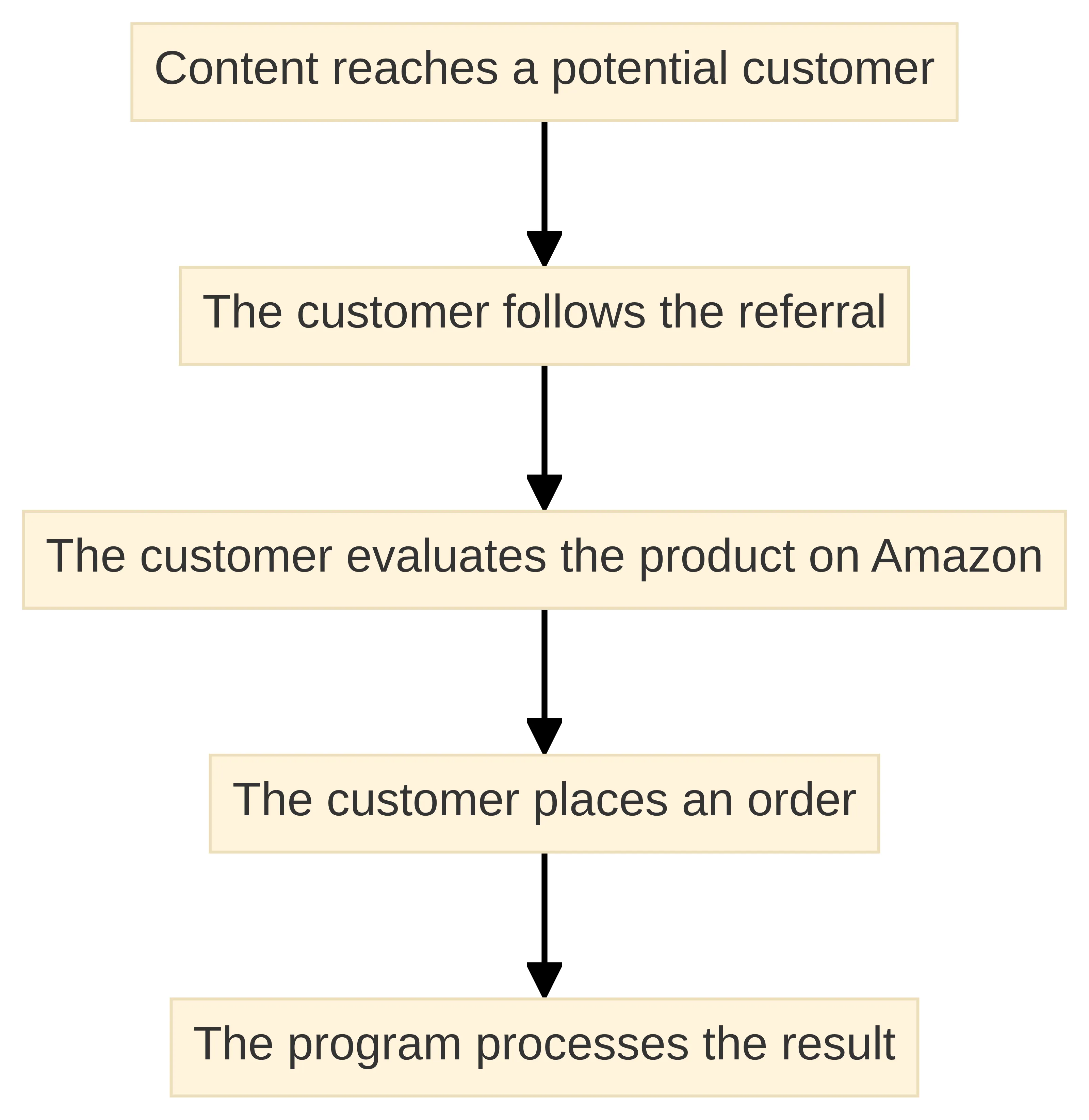
Map the journey in this order:
- Content reaches a potential customer. A publisher, creator, or Associate presents a product recommendation through an approved site or social channel.
- The customer follows the referral. The customer uses the Associate’s link or another permitted path to reach Amazon.
- The customer evaluates the product on Amazon. The marketplace experience, product detail page, price, availability, and competing choices affect the decision.
- The customer places an order. The order must meet Amazon’s current qualifying conditions for commission income to apply.
- The program processes the result. The applicable agreement, commission terms, and reporting determine whether the referral produces commission income and how the transaction is handled.
This sequence separates external demand creation from the marketplace checkout. Your team should therefore decide which part of the path it can influence, which part belongs to the partner, and which part must be measured through Amazon’s current tools and terms.
External content can help a shopper discover or evaluate a product, especially when the product requires research or the brand is trying to diversify traffic. One industry source identifies high-intent products and brands with external traction as possible fit factors. A brand-focused guide says sellers may lack visibility into which affiliates drive sales, so external reach does not automatically produce the level of partner-level reporting your team may want.
Before launch, write down the customer event you intend to influence and the information you need afterward. If you cannot connect the channel’s activity to a decision your team can make, treat that as a measurement boundary rather than assuming that more referral traffic will solve it.
Separate individual participation from brand-side partnership management
Individual Amazon Associates participation and brand-side Amazon partnership management solve different problems. Individual participation asks whether you can operate an approved publishing site or channel, follow Amazon’s terms, place permitted links or content, and earn commissions from qualifying referrals. A brand-side operation asks how your products will be introduced to partners, how those partners will be activated, how commissions will be administered, and how performance will be reviewed.
One brand-focused guide characterizes Amazon Associates as built for publishers rather than brands and says sellers may lack visibility into the affiliates driving sales. Treat that as a practical warning about control and measurement, not as an Amazon policy statement. If your objective is to recruit and manage creators or affiliate partners around your products, do not assume that opening an Associate account alone creates that operating system.
Brand-side partnership management includes recruitment, activation, commissions, partner support, and reporting. The right ownership model depends on the work your team can perform consistently.
We manage affiliate program operations including recruitment, activation, commissions, partner support, and reporting. We also offer hourly consulting for brands keeping their affiliate programs in-house, including guidance on network selection, recruitment, and incentive design. Use those service categories as a way to name the operating gap you need to fill, not as a reason to select a path before you have documented the gap.
Choose the individual participation path when your immediate question is whether your own approved content channel can generate qualifying referrals and your team can manage the applicable rules. Choose a brand-side partnership path when the main question is how to build and operate relationships with creators or affiliates who promote your products. Choose a blended approach only after you separate those responsibilities and identify who owns each one.
Verify how applications, commissions, attribution, and payouts work
Amazon says it reviews submitted websites, mobile apps, social-network pages, and Alexa skills for its customer-experience standards.
Check the current requirements for the sites and channels you intend to submit before applying.
Amazon’s selected commission table lists fixed rates by product category rather than one universal percentage. The table includes 5.00% for some luxury beauty and Amazon Coins categories and 0.50% for physical video games and video-game consoles, with other categories between those examples.
Use the current category table for the products under review. Do not build a forecast from a headline rate, an old screenshot, or a percentage borrowed from another category. Your economic test should use the applicable rate, average order value, expected order mix, returns or adjustments covered by the current terms, and the cost of finding and supporting partners.
Attribution and payouts are terms to verify before implementation. Amazon’s materials establish that commission income relates to referrals and qualifying purchases, while the operating agreement and policies govern participation. Record the current answers to these questions before you approve a launch:
- What action creates a reportable referral?
- Which order and product conditions make a purchase qualifying?
- How are cancellations, returns, or other adjustments handled?
- What reporting identifies the relevant activity?
- What payment timing, threshold, method, and account requirements apply?
Keep the answers tied to the live agreement and program documentation. If your plan depends on a tracking window, a particular reporting field, or a specific payout assumption, confirm that term before using it in a forecast or partner contract.
Treat compliance and approved content use as launch requirements
Amazon’s license allows approved Associates to use designated Program Content, Marks, APIs, and data feeds only as the agreement and specifications permit. The license is limited, revocable, non-transferable, non-sublicensable, and non-exclusive for the stated program purposes.
Your launch checklist should therefore identify which assets, product information, marks, and technical resources partners may use. Give partners instructions that match the current permissions. Do not copy marketplace content into a third-party workflow or authorize a use that the applicable license does not allow.
Amazon says commissions are not available for qualifying orders placed by the Associate or closely related parties under the conditions in its agreement. Amazon describes the program as an advertising program for referring unrelated customers, not as a way to obtain purchase discounts.
For the Influencer and Associate Programs, Amazon’s public page says qualifying participants must have an account on YouTube, Instagram, TikTok, Facebook, or Pinterest. Amazon’s application help also says submitted sites must be public and contain original content. Confirm the requirements that apply to your specific participation path, then include current disclosure obligations and content rules in the instructions you give to partners.
Balance potential business value against operating trade-offs
Amazon affiliate activity may offer a way to reach customers through external publishers, creators, and other partners instead of relying on only the traffic sources your brand already controls. One industry source identifies four potential fit factors: diversifying away from internal Amazon ads or organic traffic, having existing external traction as a newer seller, selling recurring or subscription-based products, and selling products that require substantial research before purchase.
Those factors describe situations to investigate, not outcomes to promise. A recurring product may make repeat purchases relevant to your economics, while a high-intent product may give a creator’s explanation more room to influence evaluation. Test the premise against your own margins, audience, and marketplace data.
The main trade-offs are control, visibility, cost, and operating discipline. A brand-focused guide says sellers may lack visibility into which affiliates drive their sales. Amazon’s license also limits how approved content, marks, APIs, and data feeds may be used. Those conditions can affect how precisely you brief partners, reconcile performance, and reuse marketplace information in your wider marketing workflow.
A useful channel must therefore clear more than a traffic test. Compare the expected contribution from qualifying orders with partner commissions, internal labor, management support, content review, and the cost of resolving reporting or compliance issues. If the economics work only when you assume unavailable data or unrestricted content use, revise the plan before launch.
Use a clear boundary for the decision:
- If the product can support the channel but your brand lacks partner access, focus first on recruitment and creator fit.
- If partner access exists but your team cannot manage activation, commissions, support, and reporting, define an operating owner before launch.
- If the channel appears attractive but current attribution or payout terms are unresolved, pause the forecast until those terms are confirmed.
- If compliance ownership is unclear, do not publish partner instructions or approve content until someone is accountable for the applicable rules.
Evaluate fit across product economics, audience access, and operating readiness
Your Amazon affiliate fit assessment should produce a recorded decision across five connected tests. The tests turn a broad interest in affiliate activity into conditions you can examine before implementation.
-
Product economics: Calculate the contribution left after product cost, marketplace costs, the applicable commission, expected adjustments, partner support, and internal labor. Set the minimum economics required for a test before you approach partners.
-
Audience access: Identify the creators, publishers, communities, email audiences, or other external channels that can plausibly reach the customers you want. Existing external traction is a potential fit factor, but access should be demonstrated through a partner shortlist rather than assumed from broad category popularity.
-
Measurement needs: Write the decisions your reporting must support. You may need to compare partner activity, product groups, commissions, qualifying orders, or the cost of managing the channel. Then confirm that the current Amazon program and any approved tools expose the information your decision requires.
-
Operating capacity: Assign responsibility for participation, partner recruitment, activation, content instructions, commission administration, support, reporting, and policy review. If no team can perform those tasks consistently, choose consulting or managed support before you promise partners a launch date.
-
Compliance readiness: Confirm that the proposed sites and channels meet current participation requirements, that permitted content and marks are used within the license, and that partner instructions address current disclosure and posting obligations.
This workflow does not predict earnings. It tells you whether the assumptions behind a test are explicit enough to approve, revise, or stop.
Use the results to choose the next path:
- Proceed with a small test when product economics, audience access, measurement, ownership, and compliance all have named assumptions and owners.
- Build the operating plan first when the product looks suitable but recruitment, partner support, or reporting is undefined.
- Seek specialist input when your team wants to keep the program in-house but needs help with network selection, recruitment, or incentive design.
- Defer the channel when the economics depend on unverified commission, attribution, or payout terms.
The decision is defensible when you can explain what must be true, how you will check it, and who will act if the condition fails.
Record the current Amazon requirements before implementation
Amazon requirements are date-sensitive, so create a dated record before you apply, publish, or recruit. The record should point to the current Operating Agreement, Program Policies, participation help, commission information, and any applicable creator or Associate documentation.
Capture these fields:
- Participation path: Identify whether you are applying as an Associate, using a creator-oriented path, or managing relationships with partners who participate separately.
Record the current wording and confirm that it applies to your path. - Commission schedule: Record the product categories and rates that apply to your actual assortment. Amazon’s selected table ranges from 5.00% for some luxury beauty and Amazon Coins categories to 0.50% for physical video games and consoles.
- Attribution and payout: Record the qualifying-order definition, reporting fields, payment timing, thresholds, methods, and adjustments stated in the current terms.
- Content permissions: Record which Program Content, Marks, APIs, and data feeds may be used, by whom, and under which specifications.
- Partner instructions: Record the current posting, disclosure, review, and customer-interaction requirements that apply to the planned content.
Date each entry and assign an owner for rechecking it. A requirement record is useful only while it matches the terms that govern the implementation.
Use the record as an implementation gate rather than a paperwork exercise. Do not approve a forecast that uses an unconfirmed rate, do not promise a partner a reporting field you have not confirmed, and do not distribute content instructions that exceed Amazon’s current license. Update the record when the agreement, policies, commission information, or participation requirements change.
Verify the path before committing to Amazon affiliate activity
Treat current Amazon terms as the first decision gate: verify the rules that apply to the participation path under consideration before committing resources. Start with the smallest test that those conditions can support. If a required assumption remains unresolved, make verification the next step instead of treating projected traffic or commission income as proof of fit.
We offer hourly consulting for brands that want to keep their affiliate programs in-house, including guidance on network selection, recruitment, and incentive design. We also manage affiliate program operations including recruitment, activation, commissions, partner support, and reporting. Our services include a free program audit, hourly consulting, and full-service affiliate program management.
Questions to resolve before pursuing Amazon affiliate activity
What is the Amazon Affiliate Program?
The Amazon Affiliate Program, also known as Amazon Associates, is an advertising program where approved participants can earn commissions by referring customers to Amazon. Participants publish content or use Amazon’s program materials on their approved sites, and they receive commission income when qualifying purchases are made through their referral links.
How do I qualify to be an Amazon affiliate?
To qualify as an Amazon affiliate, you must apply to the program and accept the Amazon Associates Program Operating Agreement. You also need to drive at least three qualified sales within the first 180 days of signing up, and personal orders do not count towards this requirement.
What are the commission rates for the Amazon Affiliate Program?
Commission rates in the Amazon Affiliate Program vary by product category. For example, some luxury beauty products may offer a commission of 5.00%, while physical video games may offer only 0.50%. It’s important to check the current commission table for the specific rates applicable to your products.
What should I consider before joining the Amazon Affiliate Program?
Before joining, evaluate your product economics, audience access, measurement needs, operating capacity, and compliance readiness. Ensure that your product can support the commission costs and that you have the resources to manage the affiliate program effectively.
How does the customer journey work in the Amazon Affiliate Program?
The customer journey involves several steps: a potential customer sees a product recommendation from an affiliate, follows the referral link to Amazon, evaluates the product, places an order, and the program processes the commission based on the qualifying purchase.
What distinguishes individual participation from brand-side management in the Amazon Affiliate Program?
Individual participation focuses on whether you can operate an approved site and earn commissions from referrals. In contrast, brand-side management involves recruiting and managing relationships with affiliates or creators to promote your products effectively.
What are the implications of Amazon's policies for affiliates?
Amazon’s policies restrict how affiliates can use program content and require compliance with specific guidelines.
Need help applying this?
Let's pressure-test your affiliate program.
Surge runs affiliate programs for ecommerce brands across the U.S. The audit is complementary — book a call to see what a healthier publisher mix and tighter commission design could do for your numbers.
LET'S SURGE!